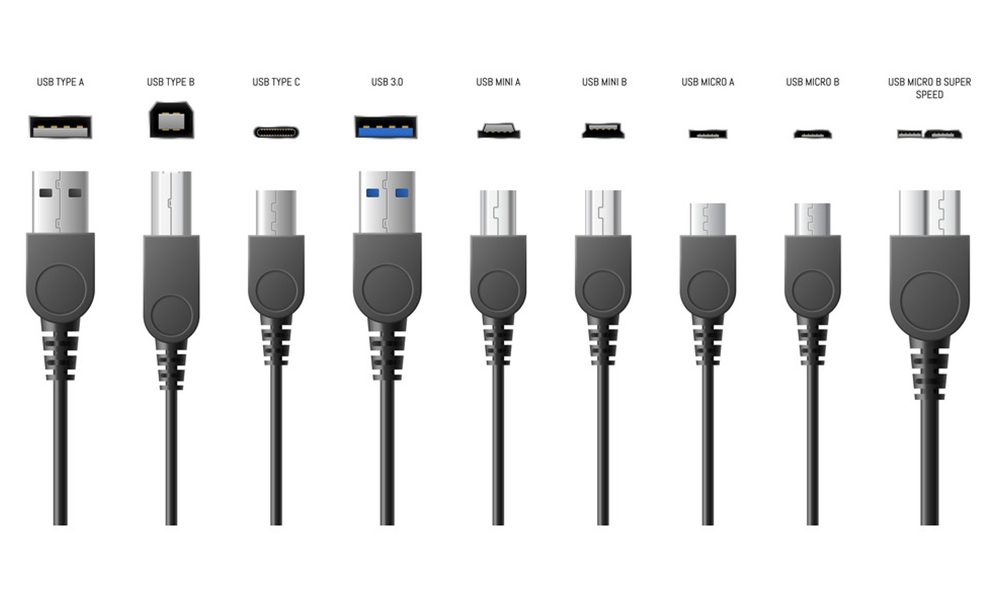
In an age where seamless digital interaction is not merely a convenience but a fundamental necessity, the humble Universal Serial Bus (USB) stands as an unsung hero. From its nascent beginnings as a simple peripheral connector to its current incarnation as a powerhouse for data transfer, video output, and power delivery, USB has undergone a truly remarkable metamorphosis. It is the invisible thread weaving through our modern technological tapestry, empowering everything from our smartphones to high-performance workstations.
Today, we find ourselves at the precipice of an exhilarating new era, driven by the relentless innovation in USB types & versions. The evolution from the familiar rectangular USB-A port to the incredibly versatile, reversible USB-C, and the astonishing leaps in data transfer speeds, are fundamentally reshaping how we interact with our devices. This isn’t just about faster file transfers; it’s about unlocking entirely new paradigms of device interoperability, streamlining workspaces, and fueling the next generation of technological breakthroughs.
Key Milestones in USB Evolution
| USB Standard | Connector Type(s) | Max Speed | Key Features & Notes | Common Use Cases |
|---|---|---|---|---|
| USB 1.0 / 1.1 (Full Speed) | Type-A, Type-B | 1.5 Mbps (Low Speed) 12 Mbps (Full Speed) | First widely adopted standard. Plug-and-play simplicity. | Keyboards, mice, low-bandwidth peripherals. |
| USB 2.0 (High Speed) | Type-A, Type-B, Mini-A, Mini-B, Micro-A, Micro-B | 480 Mbps | Significant speed increase. Introduced various smaller connectors. | Printers, scanners, digital cameras, external hard drives (older). |
| USB 3.0 / 3.1 Gen 1 / 3.2 Gen 1 (SuperSpeed) | Type-A, Type-B, Micro-B, Type-C | 5 Gbps | Often referred to as USB 3.0. Distinct blue internal color for ports. | External hard drives, flash drives, docking stations. |
| USB 3.1 Gen 2 / 3.2 Gen 2 (SuperSpeed+) | Type-A, Type-C | 10 Gbps | Doubled the speed of USB 3.0. Often marketed as USB 3.1 or USB 3.1 Gen 2. | Faster external SSDs, high-resolution displays via Type-C. |
| USB 3.2 Gen 2×2 (SuperSpeed 20Gbps) | Type-C only | 20 Gbps | Utilizes two lanes of 10 Gbps via a USB-C cable. | Ultra-fast external storage, advanced docking solutions. |
| USB4 (Gen 2×2 / Gen 3×2) | Type-C only | 20 Gbps (Gen 2×2) 40 Gbps (Gen 3×2) | Built on Thunderbolt 3 protocol. Enables dynamic bandwidth allocation, tunneling of DisplayPort and PCIe. | External GPUs, 8K monitors, professional docking stations, high-performance storage. |
For more detailed specifications and the latest updates, please visit the official USB Implementers Forum (USB-IF) website.
The journey of USB began humbly, designed primarily to simplify the tangle of serial and parallel ports plaguing early personal computers. The original USB 1.0, introduced in 1996, offered a modest 12 Mbps, which, while revolutionary for its time, pales in comparison to today’s lightning-fast standards. The subsequent arrival of USB 2.0 in 2000 dramatically boosted speeds to 480 Mbps, becoming the ubiquitous standard for over a decade and powering countless peripherals from printers to webcams. This era solidified USB’s role as the indispensable backbone of digital connectivity, proving incredibly effective in its widespread adoption.
Then came the game-changer: USB 3.0, later rebranded as USB 3.1 Gen 1 and then USB 3.2 Gen 1, launched in 2008 with a blistering 5 Gbps. This “SuperSpeed” leap was truly transformative, enabling the rapid transfer of large files that previously took agonizing minutes. Imagine downloading an entire movie in mere seconds – that’s the kind of paradigm shift USB 3.x brought, profoundly impacting data-intensive industries and everyday users alike. Its distinct blue port became a visual cue for enhanced performance, a promise delivered consistently across millions of devices globally.
However, the most visible and perhaps the most impactful evolution has been the advent of the USB-C connector. Introduced alongside USB 3.1, this reversible, slim connector has proven to be a marvel of engineering and design. No longer do users struggle with orienting a plug; USB-C connects flawlessly every single time, offering unparalleled user convenience. More importantly, it’s a remarkably versatile chameleon, capable of transmitting power (up to 240W with USB Power Delivery 3.1), video (DisplayPort Alternate Mode), and data, all through a single cable. This singular port is dramatically simplifying our digital lives, facilitating sleek, minimalist setups for laptops, tablets, and even high-end monitors, thus driving a new era of connectivity.
The latest frontier is USB4, a truly groundbreaking standard that leverages the underlying Thunderbolt 3 protocol. This integration is not merely an incremental upgrade; it represents a seismic shift, propelling speeds up to a staggering 40 Gbps. More than just raw bandwidth, USB4 intelligently allocates resources, allowing for simultaneous high-resolution video streams, external GPUs, and lightning-fast storage, all powered by a single, elegant USB-C cable. As industry leader Brad Saunders, Chairman of the USB-IF, eloquently stated, “USB4 brings the next generation of USB architecture to enable the most compelling user experiences, delivering a universal single cable solution.” This vision is rapidly becoming our reality, empowering creators, gamers, and professionals with unprecedented capabilities and transforming workflows globally.
The implications of these advancements are profound. Businesses are experiencing vastly improved operational efficiencies, with external storage devices performing at near-internal SSD speeds, and complex multi-monitor setups requiring only a single connection to a laptop. For consumers, the promise of a truly universal charging and data standard is finally materializing, reducing cable clutter and simplifying device management. Experts widely agree that USB-C, especially when combined with USB4, will continue to be the cornerstone of future device ecosystems, driving innovation across a multitude of sectors, from augmented reality to sustainable computing. This thoughtful engineering is steadily paving the way for a more connected and efficient world, ensuring our digital future remains bright and seamlessly integrated.
From its humble origins to its current role as a technological linchpin, the evolution of USB types & versions vividly illustrates the relentless pursuit of progress. We are witnessing not just an incremental improvement but a fundamental reimagining of how our devices connect, communicate, and power our digital lives. The future, powered by the incredible capabilities of USB-C and USB4, promises an era of unprecedented speed, versatility, and seamless integration. Embrace this evolution, for it is undeniably shaping a more efficient, interconnected, and exciting technological landscape for us all.