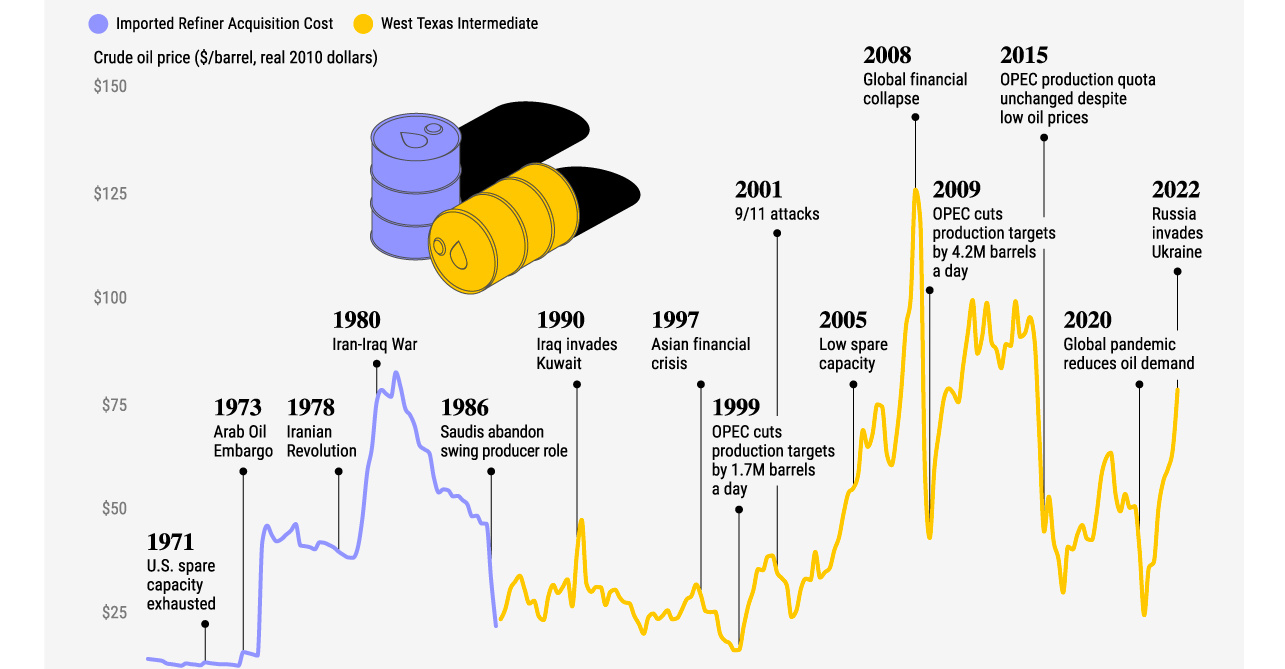
The global economy‚ an intricate tapestry of interconnected markets and industries‚ frequently finds its rhythm dictated by a single‚ potent metric: the price of oil. Far more than just a commodity‚ crude oil remains the lifeblood of modern civilization‚ fueling everything from international trade to daily commutes. Consequently‚ understanding the complex dance of supply and demand‚ reflected vividly in the Oil Price Chart‚ is no longer merely an academic exercise for energy analysts; it is an absolute imperative for investors‚ policymakers‚ and forward-thinking businesses alike‚ profoundly influencing strategic decisions across continents and capital markets.
In an era characterized by unprecedented geopolitical shifts‚ rapid technological advancements‚ and an accelerating energy transition‚ the seemingly simple lines and curves of an oil price chart hold a wealth of information. This dynamic visual narrative‚ constantly updating with every transaction‚ offers critical insights into the underlying health of the global economy‚ the efficacy of diplomatic maneuvers‚ and the pace of industrial innovation. By meticulously dissecting these charts‚ we gain an unparalleled vantage point‚ transforming what might appear as mere historical data into a powerful predictive tool‚ enabling stakeholders to navigate future uncertainties with remarkable precision and confidence‚ thereby seizing opportunities that were once shrouded in market opaqueness.
| Key Information: Understanding the Oil Price Chart | |
|---|---|
| Definition | A graphical representation displaying the historical and real-time fluctuations of crude oil prices over a specified period. It’s a fundamental tool for market analysis. |
| Major Benchmarks |
|
| Primary Influencing Factors |
|
| Analytical Approaches |
|
| Reference Website | U.S. Energy Information Administration (EIA) |
Historically‚ oil markets have been a crucible of volatility‚ repeatedly tested by geopolitical shocks and economic booms and busts. The 1970s oil embargoes‚ the Gulf Wars‚ and the 2008 financial crisis each etched indelible patterns onto the oil price chart‚ leaving behind a profound legacy of price surges and precipitous declines. These historical precedents‚ meticulously documented and extensively analyzed‚ offer invaluable lessons‚ shaping contemporary risk management strategies and informing long-term investment horizons for an entire generation of energy executives. Learning from these past events is crucial for anticipating future market dynamics.
Today‚ the landscape is incredibly complex‚ with a multitude of factors perpetually tugging at crude prices. On the supply side‚ the coordinated actions of OPEC+ nations‚ the remarkable resilience of U.S. shale producers‚ and the persistent threat of geopolitical instability in the Middle East and Eastern Europe continuously influence global output. Simultaneously‚ demand dynamics are shifting dramatically; while emerging economies continue to drive consumption‚ developed nations are increasingly embracing renewable energy sources and electric vehicles‚ thereby gradually tapering their reliance on fossil fuels. This intricate interplay creates a fascinating‚ albeit challenging‚ environment for market forecasting.
However‚ the future is not merely a rerun of the past. Advanced analytics‚ powered by artificial intelligence and machine learning‚ are fundamentally revolutionizing how we interpret the oil price chart. By integrating insights from AI-driven algorithms capable of processing vast datasets—including satellite imagery of oil storage facilities‚ sentiment analysis of financial news‚ and real-time shipping data—analysts are now formulating remarkably accurate predictive models. This technological leap transcends traditional technical and fundamental analysis‚ offering a holistic perspective that captures subtle market signals previously undetectable‚ enabling more informed and agile decision-making across the energy value chain.
For businesses‚ understanding the nuances of the oil price chart translates directly into competitive advantage. Energy producers can strategically optimize extraction rates and hedging strategies‚ while airlines and shipping companies can more effectively manage fuel costs‚ a significant operational expense. Furthermore‚ governments‚ tasked with ensuring energy security and economic stability‚ rely heavily on these charts to craft effective fiscal policies‚ manage strategic reserves‚ and guide their transition toward a greener future. The chart‚ therefore‚ becomes a shared language‚ uniting diverse stakeholders in a common pursuit of resilience and prosperity.
Looking ahead‚ the oil price chart will remain an indispensable tool‚ albeit one interpreted through an increasingly sophisticated lens. As the world progresses towards decarbonization‚ the chart will not only reflect the ebb and flow of traditional crude markets but also the burgeoning influence of carbon pricing‚ green energy investments‚ and evolving regulatory frameworks. This forward-looking perspective suggests that mastering the oil price chart‚ empowered by cutting-edge technology and astute analysis‚ will be paramount for anyone aspiring to thrive in the dynamic‚ evolving energy landscape of the 21st century. The opportunities for those who can read its story are truly immense‚ promising a future where informed decisions lead to sustainable growth and unparalleled success.