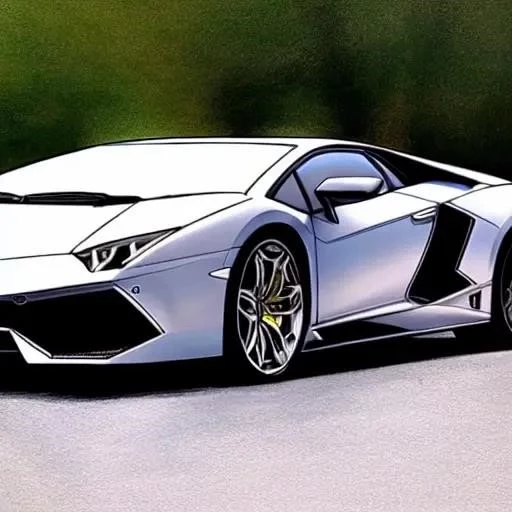
Few marques ignite the imagination quite like Lamborghini. Its vehicles, sculpted marvels of engineering and design, command attention, embodying speed, luxury, and an almost primal aggression. But what if you could capture that breathtaking essence, not with a million-dollar investment, but with a humble pencil and paper? This dream, once reserved for seasoned automotive designers, is now incredibly accessible to aspiring artists everywhere, offering a gateway to understanding the profound beauty of industrial art.
Embarking on the journey to draw a Lamborghini car is more than just mimicking lines; it’s about understanding form, perspective, and the audacious spirit embedded within every curve and angle. It’s a remarkably rewarding artistic endeavor, promising not only enhanced drawing skills but also a deeper appreciation for the intricate artistry behind these iconic supercars. By meticulously deconstructing their dynamic profiles and aggressive stances, artists gain invaluable insights into automotive aesthetics and the principles of compelling visual design, transforming a mere sketch into a vibrant expression of power and elegance.
| Category | Key Information / Elements | Description / Relevance |
|---|---|---|
| Essential Tools & Materials | Graphite Pencils (2H to 6B), Sketchbook (heavyweight paper), Kneaded Eraser, Blending Stumps, Ruler | These foundational items are crucial for achieving varied line weights, smooth shading, and precise geometric forms, forming the bedrock of any successful drawing. |
| Core Artistic Techniques | Perspective (1-point, 2-point), Proportions, Basic Geometric Shapes, Line Weight, Shading & Rendering | Mastering these techniques allows artists to create realistic depth, maintain accurate scale, and imbue drawings with volume and texture, making the car appear three-dimensional. |
| Lamborghini Design Principles | “Y” Motif, Sharp Angles, Low Profile, Aggressive Stance, Hexagonal Elements, Dynamic Aerodynamics | Understanding these signature design cues is paramount for authentically capturing the brand’s unique visual identity and conveying its inherent speed and power. |
| Recommended Learning Approach | Reference Photos, Sketching Basic Forms, Focusing on Silhouette, Layering Details, Practice & Patience | A structured, iterative approach, starting with broad strokes and gradually adding complexity, is incredibly effective for breaking down the challenge into manageable steps. |
| Reference Link | Concept Art World | A valuable resource for aspiring artists, offering inspiration, tutorials, and a community focused on design and visual development, including automotive concepts. |
The initial step in capturing a Lamborghini’s formidable presence involves mastering foundational geometric shapes. Envisioning the car not as a single complex object but as a composite of interconnected cubes, cylinders, and wedges simplifies the daunting task. Crucially, understanding one-point and two-point perspective allows artists to accurately represent depth and dimension, making the vehicle appear grounded and realistic rather than floating aimlessly on the page. This methodical approach, patiently applied, forms the bedrock for all subsequent detailing, transforming an abstract concept into a tangible form.
Once the basic structure is confidently laid out, the true character of the Lamborghini begins to emerge through precise line work. Focus intently on the distinctive ‘Y’ motif often found in their headlights and air intakes, alongside the signature sharp, angular body panels that define its aggressive silhouette. Observing reference images critically is paramount; pay attention to how light interacts with the surfaces, creating dramatic contrasts and reflections that convey the car’s inherent dynamism. Expert automotive designers often speak of ‘tension’ in their lines, a concept aspiring artists can internalize by making every stroke count, reflecting power and forward motion, compellingly drawing the viewer’s eye across the form.
Beyond mere outlines, shading and detailing inject life and volume into your drawing. Employing various pencil grades, from soft B-pencils for deep shadows to hard H-pencils for crisp highlights, meticulously renders the metallic sheen and textural nuances of the bodywork. Consider the subtle reflections on the windshield and the intricate spokes of the wheels – these elements, though challenging, contribute immensely to the overall realism and impact. Ultimately, drawing a Lamborghini is an act of passionate translation, conveying not just its physical attributes but also the raw emotion and aspirational spirit it embodies, truly bringing the supercar to life on paper.
The journey from a blank page to a stunning rendition of a Lamborghini is immensely satisfying, a testament to dedication and artistic vision. It’s a skill cultivated through consistent practice, keen observation, and an unwavering passion for both art and automotive excellence. By embracing these techniques and allowing your creativity to flourish, you’re not just drawing a car; you’re developing a profound skill set that transcends mere imitation. So, pick up your pencil, embrace the challenge, and prepare to bring the electrifying spirit of Sant’Agata Bolognese to life, one powerful stroke at a time. Your masterpiece awaits!